
Florence County Civil Docket Searches
For Florence County civil court dockets, the public online route is Wisconsin Circuit Court Access, or WCCA. Pick Florence in the county field. A known case number gives the most exact match. A party or business name works too. Each result shows the case number, filing date, county, public status, party name, and caption. Click the case number to open its summary and full history.
Wisconsin case numbers follow a pattern: four digits for the year, two letters for the case type, then a six-digit sequence. General civil matters use CV, as in 2024CV000001. Other codes cover small claims, family, and probate. When a common name pulls up too many matches, WCCA's advanced search can filter by class code, case type, case status, attorney or state bar ID, filing and disposition dates, and case-number ranges. Those filters narrow a crowded docket search fast.
- Open WCCA and set County to Florence.
- Enter a case number, complete party name, or business name.
- Compare the result's county, case number, filing date, status, and caption.
- Open the case and review parties, activities, court record, documents, and judgments.
- Ask the Florence clerk for the actual filing or a certified judgment when needed.
The clerk of court keeps more than one door open. At 501 Lake Avenue, a courthouse terminal reaches WCCA during office hours, 8:30 a.m. to 4:00 p.m. Quick question about a hearing or a record? Call 715-528-3205. Written copy requests go by mail to P.O. Box 410, Florence, WI 54121, once fees are confirmed. Wisconsin's public-records policy backs inspection and copies too, bounded only by the confidentiality rules courts apply.
Florence Civil Dockets in CCAP
Behind the scenes sits CCAP, the Consolidated Court Automation Programs. It runs case management, calendars, financial work, electronic documents, jury operations, and eFiling. All of this serves Wisconsin circuit courts. Florence County relies on this statewide platform. The county's own circuit-court records link simply routes to WCCA. The Wisconsin Court System's CCAP overview lays out how internal court operations connect to public access.
One system, two layers. CCAP holds electronic records for the courts, while WCCA shows the public a narrower slice. So a filing can turn up in Florence County case history yet carry no viewable document image, and nothing is wrong when it does.
Civil Dockets: What They Show
Open a Florence County civil court docket and you meet a header first. The civil summary lists public fields. These include the case number, caption, filing date, case type, status, class-code description, responsible official, and branch identifier. Staff sometimes link related public cases, which is why cross-referenced case numbers show up. Below that, the parties block names each side's role. It also gives attorney information, where protection rules allow.
| Case number | The year, case-type letters, and sequence assigned to the Florence County file. |
|---|---|
| Parties | Plaintiff, petitioner, defendant, respondent, or another role, plus attorney data when public. |
| Activities | Dated entries for pleadings, notices, orders, hearings, judgments, dismissals, and other action. |
| Court record | Entries in the official record, which are distinct from free copies of the filed papers. |
| Civil judgments | A separate judgment-information block when the system publishes one. |
| Cross-reference | A related case number when the connection was entered and the linked case is public. |
Look at each dated entry together with the case status and any signed order. A docket line that says "judgment" might describe a filing rather than an outcome. Certified judgments come from the clerk alone. A dismissal entry deserves the same care. It only makes sense once you match it to the claim and the order behind it.
Florence Case Summary Versus File
Scroll a Florence County civil docket on WCCA. You will see what happened, not the papers themselves. A motion, affidavit, complaint, order, judgment, or exhibit can sit in the official court file. It may never appear as a download. That is normal. The case summary simply notes that some activity took place on the case.
For the actual documents, go to the Florence County Clerk of Circuit Court. The clerk's office holds the public file. Its staff can arrange inspection or copies of anything open to the public. Some papers are restricted, though. A docket entry that mentions them does not unlock them. If an entry points to sealed material, the courthouse cannot hand it over.
The Wisconsin court redaction FAQ lays out what stays off the online docket. It also tells you to send document or transcript requests to the courthouse in the county where the case was filed.
For Florence County, that instruction points to the unified circuit clerk. No separate civil county clerk exists, and the county offers no Florence-specific online portal for ordering documents.
What Cases Fill the Civil Docket
Wisconsin Circuit Court, Florence County Branch 1, holds original jurisdiction over civil matters. It also takes family, small-claims, probate, juvenile, traffic, and other case types. So a Florence County civil docket is really several streams of disputes under one roof. Those disputes all sit under one roof. WCCA's class-code and case-type filters let you narrow a docket search. They help you pick just the stream you need.
- General civil claims involving contracts, torts, property, or other private disputes.
- Small-claims cases handled within the circuit-court system.
- Family matters, including divorce, support, maintenance, and paternity files.
- Probate proceedings administered within the unified circuit structure.
- Other civil-side cases that remain public under Wisconsin access rules.
Family, probate, juvenile, and protective cases often carry confidentiality limits that hide files from plain view. So a missing online file proves nothing about whether a proceeding exists. Before concluding anything, confirm the case type and its access status with the Florence County clerk.
Florence Civil and Family Counts
Florence County's certified 2024 report counts, across every circuit category, 669 cases opened and 680 disposed. Another 100 cases were pending at year end. That is the whole court docket workload, not general civil alone. "Opened" and "filed" are not the same measure either. Opened totals can include transferred, reopened, or reactivated matters. For a closer look at one civil-side group, turn to the separate 2024 family disposition report.
The family report lists 14 divorce dispositions, five support or maintenance, one paternity, and 21 family matters in all. County-wide totals like these cannot predict how long one case will run or how it ends. They do remind you to pick the right case type before reading meaning into a docket result list.
Hearings on the Civil Docket
A hearing on a Florence County civil court docket shows as an activity. It comes with a date and a short description. That is the starting point, not the whole story. WCCA's court-official calendar adds detail when it exists: time, case number, caption, activity type, county and location, court official, and attorneys. Set the filter to Florence. The circuit judge covers both Florence and Forest counties.
A listed activity might be a status hearing, a motion hearing, a scheduling conference, a review, or a trial. Treat none of them as the final trial date. Later entries can continue, adjourn, reschedule, or cancel what the calendar showed. Recheck the case history. Then call the clerk when a date gets close or clashes with a notice you received. For a fuller walk-through of the calendar fields, see the Florence County court schedule. It also covers the seven-day search window.
One more caution belongs here. A signed scheduling order can control deadlines. A single calendar row never reveals them. When an old public activity conflicts with the filed order or current clerk information, the order and the clerk win.
Florence Civil Filing Routes
Florence County's local rules permit civil filings through Wisconsin Circuit Court eFiling. Mail and in-person delivery also work. Email is out. Fax gets rejected too, except for the stated traffic-plea exception. The county contact form is only for questions, never a civil pleading. The Wisconsin Circuit Court eFiling system is an authenticated filing tool. Its login screen shows what a filer, not an anonymous civil docket searcher, sees.
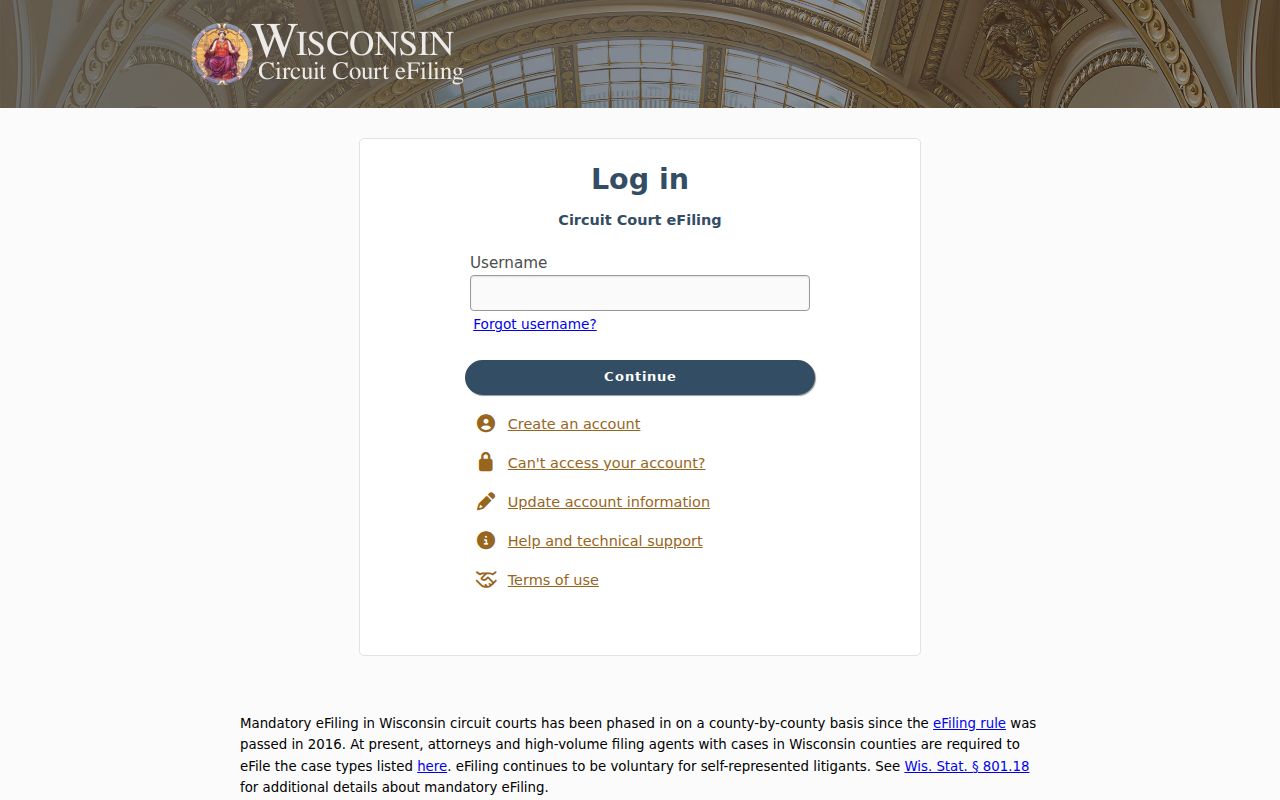
After login, attorneys and other authorized filers get My Cases and document functions. The public should stick with WCCA for case information and the clerk for documents. Wisconsin added two-factor authentication to eCourts applications in 2025, yet anonymous WCCA browsing stays separate from that login.
Florence Civil Jury Cancellation Rule
One local rule can cost real money. The signed Florence County circuit rules say a jury trial that is not timely canceled under the rule's conditions can trigger a $1,000 jury fee. That charge is specific to this local court rule. It is not a general filing fee, and it never applies automatically to every civil case on the docket.
Check the signed rule and case order. A party should not infer a cancellation deadline or fee from a WCCA status line alone. The actual notice, scheduling order, and current local rule control.
This is why a docket summary and the complete file serve different needs. WCCA can show that a trial or an order was entered. The filed scheduling materials hold the terms that actually govern the parties.
Who Can See Civil Dockets
Most Florence County civil court dockets are open to anyone. WCCA, courthouse terminals, and the clerk all provide access. Wisconsin's public-records policy leans toward access. But statutes, court rules, sealing orders, and redaction duties still shield certain information. Full Social Security numbers, financial-account numbers, driver license numbers, passwords, and similar protected identifiers never appear in public display.
Wisconsin Statute section 19.31 lays out the public-records policy. Section 19.35 covers inspection and copying. Juvenile records follow their own confidentiality rules under sections 48.396 and 938.396. Sealed family, juvenile, and protective matters may show up as limited entries online. Or they may not appear at all.
A missing result has several possible causes. Recheck the county, spelling, case type, and date range, then ask the clerk about older coverage or access limits without assuming the case does not exist.
The official eFiling help page shows how authorized My Cases users see parties, documents, and restricted-document indicators.
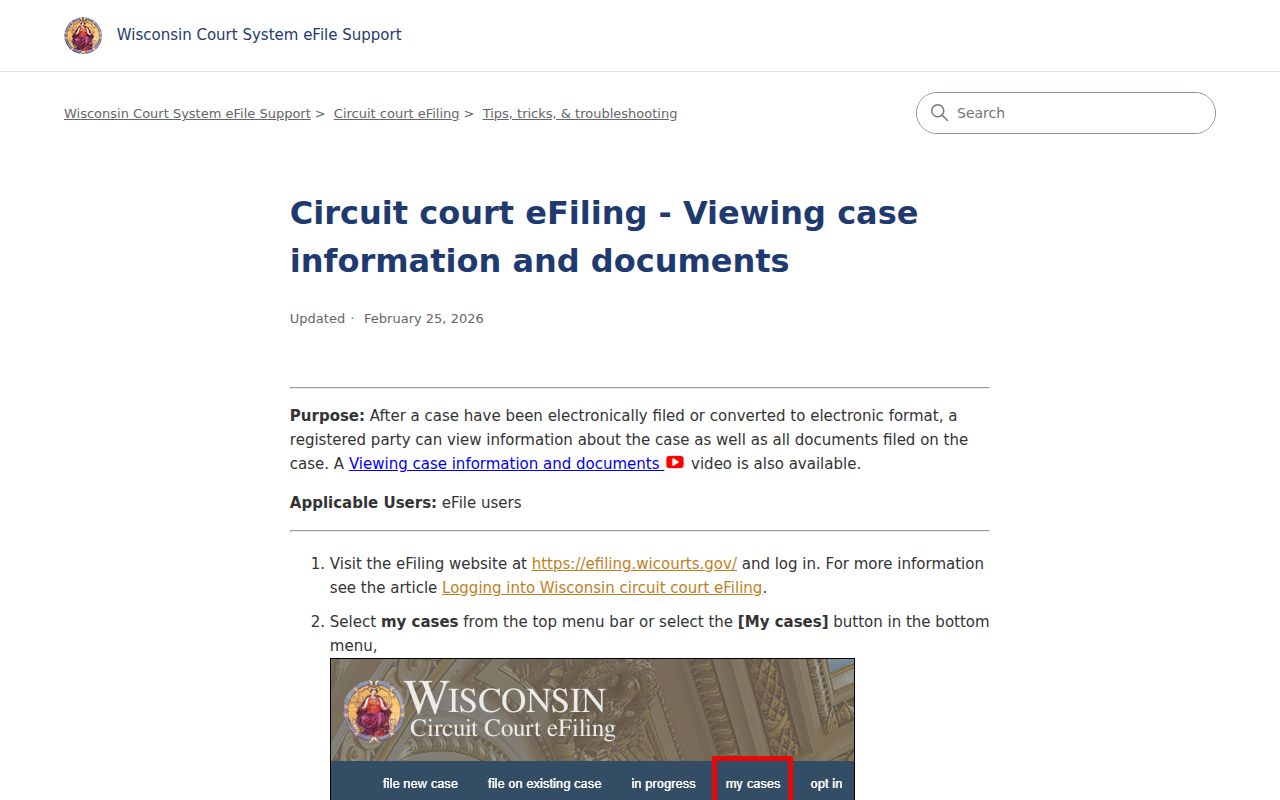
A login does not make every civil filing a public download. Access still turns on the record itself, the user's authority, and the court's confidentiality rules.